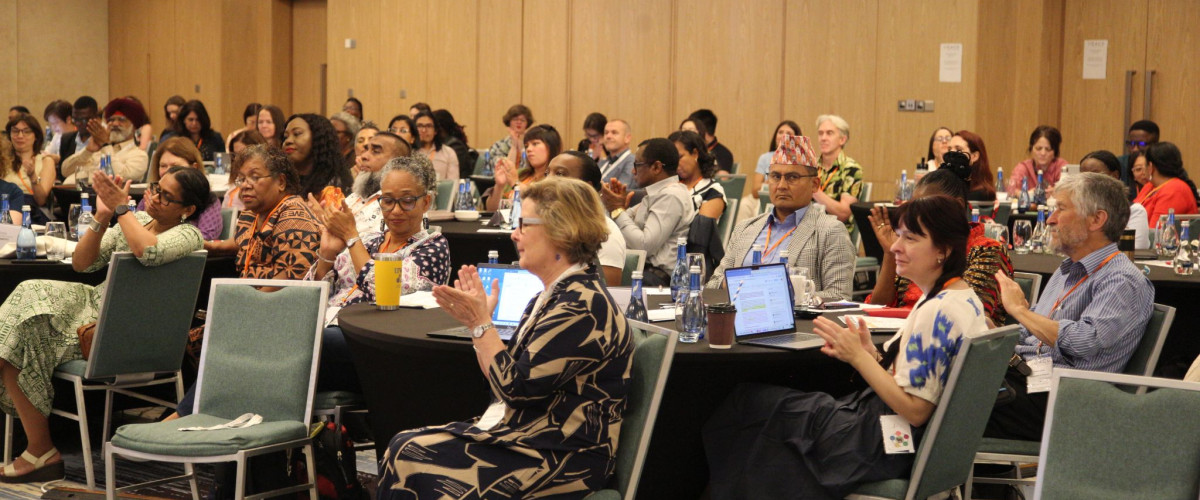
We are delighted to announce the venue and dates for the Annual Scientific Meeting 2026!
Duration: Three full days
Dates: Tuesday 3 to Thursday 5 November 2026
Location: London, UK
Venue: Hilton London Wembley
Application deadline: 2 October 2026
Draft agenda: Download here
-
For members of GACD-funded project teams, click here to register.
For active GACD projects
In the first instance, two people from each GACD project are invited to attend. At least one should be from a low/middle-income country or a member of an Indigenous community. We strongly encourage early-career researchers to attend.
In addition, a third delegate place is open to project teams who wish to bring a policymaker as part of their project representation. We will be encouraging participation of policymakers in the ASM.
Project teams should draw funds from their project budgets for travel and accommodation.
For completed GACD projects
Members of the GACD community whose projects have ended who wish to participate in the Annual Scientific Meeting are welcome to register at no cost; however, they must secure their own funding for travel and accommodation.
In September, we will review registrations and, pending numbers, will open registration to allow project teams to send more than two delegates.
For GACD-CONNECT alumni
Following the successful pilot in 2025, GACD-CONNECT alumni will be invited to apply to attend. Up to 10 alumni from GACD Schools and Masterclasses, who have no other connection with GACD, will be selected. Selected alumni must secure their own funding for travel and accommodation. To register as a GACD-CONNECT alumni, click here.
-
Feedback
As part of the registration process, you will be able to share feedback on the draft agenda and volunteer to speak, facilitate, and otherwise contribute.
On the registration form, all delegates can indicate their preferred topics for the cross‑cutting plenary sessions. This year’s topics have been shaped through discussions with Research Network members during the online Research Programme Workshops, as well as input from our working groups, special interest groups, and governance board.
When registering, you will be invited to select the two topics that interest you most.
Your input will help shape the final programme and ensure it reflects the priorities and interests of the GACD community.
Delegate contribution opportunities
You can explore the different session formats and ways to get involved in the draft agenda above. If any of these opportunities appeal to you, simply indicate your interest when completing the registration form - we will use this information to create a shortlist of potential contributors.
Speakers and facilitators will be confirmed once ASM attendance is finalised, initial feedback on the draft agenda has been reviewed, and we have a clearer sense of delegates’ topic interests. We aim to involve as many participants as possible; however, roles are limited and cannot be guaranteed.
When selecting contributors, we will particularly seek to support delegates who:
Have participated in the GACD Communication Skills for Impact Workshop Series
Are earlier in their careers and would benefit from the experience
Are based in low- and middle-income countries and/or are members of Indigenous communities
Step into a contributor role...
Upskilling Labs demonstrator: Share a practical skill or tool in an informal five‑minute “how‑to” demo with a small group, helping fellow delegates build confidence in areas such as research methods, communication, or digital engagement.
Conversation Group facilitator: Lead an informal, peer‑to‑peer discussion on a topic of your choice, creating a relaxed space for delegates to exchange ideas, experiences, and questions. Usually scheduled for the early morning slot at 8:30 AM.
Parallel session chair and/or speaker: Contribute to a themed session by presenting insights and/or guiding discussion, helping participants explore emerging topics and engage in meaningful dialogue.
World Café facilitator: Host a table within a structured, rotating discussion format, guiding small‑group conversations on key questions and capturing shared insights.
Real World Results Spotlight speaker: Present key findings from a completed project, focusing on practical, real‑world relevance for policy, practice, and communities.
Early Career Researcher Showcase speaker: Deliver a short, supported lightning talk highlighting a key insight, lesson, or question from your work, as part of a curated session showcasing early‑career perspectives. See the last page of the draft agenda for more details.
Connecting the Dots speaker: Help synthesise the meeting by reflecting on key themes, insights, and connections across sessions, contributing to a closing plenary that brings the ASM together.
-
During registration, you can request a formal letter of support from GACD. This letter will confirm your invitation to attend the Annual Scientific Meeting and include the meeting dates, venue, and endorsement from GACD funding agencies.
Information on visa requirements for travel to the UK is available on the UK Government website.
Visa requirements vary depending on nationality and individual circumstances. Many international delegates attending academic meetings in the UK apply for a Standard Visitor Visa, but GACD is unable to provide immigration advice. You are responsible for confirming the appropriate visa for your situation and for making your own visa arrangements.
Details of foreign embassies, high commissions and consulates in the UK, including heads of mission can be found here: Foreign embassies in the UK - GOV.UK (www.gov.uk)
-
The GACD Knowledge Sharing Competition is an opportunity to showcase your project or working group, or an aspect of it. All entries will be on display during the Annual Scientific Meeting for the GACD community to browse, discuss, and feedback.
How to enter
1. Read the guidance document
Knowledge Sharing Competition 2026 guidance.
2. Choose your stream
Stream 1 Creative Communication or Stream 2 Science Showcase.
3. Tell us you plan to enter
Complete the quick Intention to Participate Form.
4. Formally confirm your entry details
Fill in all the necessary details.
Email to admin@gacd.org by Friday 16 October 2026, 08:00 UTC.
-
How to enter
1. Read the guidance document
2. Tell us you plan to enter
Complete the quick Intention to Participate Form.
3. Formally submit your film in its final format
Send the required information as per the guidance document to admin@gacd.org by Friday 16 October 2026, 08:00 UTC.
-
Choosing London
This choice reflects a Governance Board recommendation to rotate Annual Scientific Meeting locations across regions, with London serving as a regular anchor city every three years. Hosting the meeting in London also helps us manage costs by reducing staff travel requirements, while offering excellent value as a well‑connected global transport hub. In addition, London is a diverse and multicultural city that meets the full range of criteria we consider when selecting ASM venues, including safety, suitability of facilities, air quality, and being welcoming to LGBTQI+ communities.
About London and the UK
London is the capital city of the United Kingdom of Great Britain and Northern Ireland.
Constituent countries of the UK: England, Scotland, Wales, and Northern Ireland
Total area: 242,495 km2 (93,628 sq mi)
Population: 67,791,400 (2022 estimate)
Currency: Pound sterling (GBP)
Time zone during the Annual Scientific Meeting: Greenwich Mean Time, GMT (UTC +/- 0)
Driving side: Left
Calling code: +44
Cups of tea drunk per year: 36 billion (no, really!)
If you experience an emergency while in the UK, the emergency services can be reached by dialling 999.
Helpful websites
The following websites are shared as helpful points of reference for delegates. The GACD does not formally endorse them and accepts no responsibility for any errors published on the websites.
Foreign embassies in the UK - GOV.UK (www.gov.uk)
Transport for London – tfl.gov.uk
Free London travel maps – visitlondon.com
Welcome to London – visitlondon.com
Experience London – Lonely Planet | England, Europe
Best Attractions in London | 50 Essential London Sights You Have to See – timeout.com
-
Venue: The Hilton London Wembley
Address: Lakeside Way, Wembley Park, Wembley, London, HA9 0BU, United Kingdom
Website: Hilton London Wembley
Nearest airports:
Heathrow Airport (14 miles)
Luton Airport (31 miles)
London Stansted Airport (42 miles)
Nearest train stations:
Wembley Stadium (national rail)
Wembley Park (London Underground – Jubilee Line and Metropolitan Line)
Wembley Central (London Underground – Bakerloo Line)
Delegates are welcome to stay at the Hilton London Wembley (and we will have codes to give you special rates); however, you are welcome to select accommodation that best suits your needs. There are plenty of nearby options.
-
GACD is following guidance from the WHO on delivering a healthy and sustainable in-person meeting.
Menu options
All menu items have been carefully selected to be in line with WHO guidance, providing healthy and delicious options for delegates. Delegates’ dietary requirements (as indicated on the registration form) have been discussed with venue staff and appropriate options will be clearly indicated or alternatives provided.
Physical activity
The WHO recommends offering meeting delegates safe and appropriate opportunities to be physically active and to achieve the recommended 150 minutes of moderate-intensity physical activity per week by creating a physically active environment.
Opportunities for physical activity during meeting sessions:
Active breaks built into the agenda.
Delegates are encouraged to stand during sessions at their discretion; the GACD staff team will lead by example.
Longer lunch breaks and breaks between the end of the meeting sessions and the start of the evening socials for delegates to take a walk, go on a short run, do some light yoga, or another activity.
Tobacco-free
The venue is non-smoking in all public areas and bedrooms. In addition, UK law prohibits smoking in indoor public places, including the Annual Scientific Meeting venue.
-
Environmental impact
Information on impact and mitigation at the venue was provided by staff at the Hilton London Wembley in 2022 and will be updated this year when the latest figures are provided.
The estimated environmental impact of hosting the Annual Scientific Meeting is:
Energy use: 150,622 KBTUs
Water use: 80,262 gallons
Waste: 545 kilograms
Carbon dioxide emissions: 7.2 MT of CO2e
Impact calculations for carbon emissions, energy and water consumption, and waste follow the Hotel Carbon Measurement Initiative v1.2, Hotel Water Management Initiative v1.1, and Hotel Waste Measurement v1.0 methodologies.
Mitigations at the venue
The venue has reported the following sustainability activities to minimise the environmental impact of events held on their site:
Energy efficiency
Use of renewable energy
Energy efficient lighting
Energy efficient equipment
Venue staff trained on conserving energy
Water conservation
Water efficient showerheads
Low-flow taps (faucets)
Water efficient landscaping
Venue staff trained on conserving water
Waste reduction
On-site recycling
Food donation programme
Soap recycling programme
Plastic reduction initiatives
Paper reduction initiatives
Other mitigations
Further mitigations undertaken by the GACD team to minimise the environmental impact of the Annual Scientific Meeting include:
Limiting the total number of documents and total number of copies printed.
Where printing is necessary, using recycled paper.
Selecting a venue that is well connected via public transport links.
The majority of delegates are anticipated to use public transport to travel to/from the venue.
All staff will be using public transport to travel to/from the venue.
Would this content be useful for a friend or colleague?