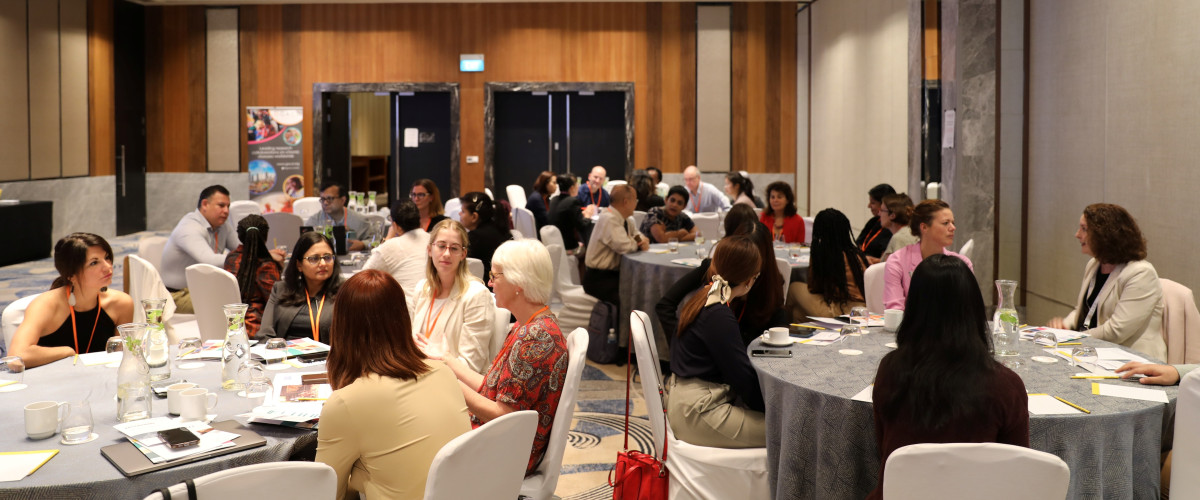
Working groups and Special interest groups are a pivotal mechanisms in facilitating collaborations across geographic and institutional borders. Together, GACD researchers tackle key themes linking diseases, contexts, interventions, methodologies, and outcomes.
This webpage provides an overview of our working groups and special interest groups, past and present. All the outputs noted below are also listed in our publications portals under working groups.
Are you a member of the Research Network and looking to set up a working group, special interest group, or once-event? Download a proposal form and send it to science@gacd.org:
You may also download the Research Network terms of reference.
Active special interest groups
Our special interest groups foster informal, ongoing discussions among researchers who share common passions. Members of the Research Network are warmly welcome to join a group to connect with like-minded individuals and explore new ideas. Typically, special interest groups are not time-limited.
-
More information coming soon
-
This special interest group is chaired by Anu Oommen and Jiani Ma.
Aims
The group seeks to contribute to the global movement for democratising implementation research. By challenging the status quo and advocating for more equitable approaches, the group can help to address systemic inequalities in the field.
The working group will develop actionable steps for individuals and institutions, with a focus on funding alignment. This will involve identifying specific actions that can be taken at both individual and institutional levels to promote equity in implementation science.
Proposed outputs include a commentary, resources on the GACD webpage, and an accompanying online launch are planned. These outputs will serve as valuable tools for raising awareness, providing guidance, and driving change in the field.
-
This working group is co-chaired by Kym Yuke and Violet Naanyu.
Aim
To facilitate equitable, genuine and mutually beneficial collaboration between researchers and Indigenous communities and provide mentoring and learning opportunities for Indigenous researchers and people working with Indigenous communities.
Outputs
The condensed researchers’ statement: Meharg DP et al. (2023) The Global Alliance for Chronic Diseases researchers’ statement on non-communicable disease research with Indigenous peoples. Lancet Glob Health. 11(3):e324-e326. doi: 10.1016/S2214-109×(23)00039-6.
You can access the full Indigenous populations working group statement here.
Group member, Jennifer Alison, presented an update during the GACD Annual Scientific Meeting 2023.
-
This working group is chaired by Pablo Perel and Éimhín Ansbro.
Aims
In collaboration with the London School of Hygiene and Tropical Medicine Centre for NCDs in Humanitarian Settings, this GACD working group is creating practical resources for humanitarian aid organisations to use in the prevention and management of NCDs, especially in the context of the COVID-19 pandemic.
A narrative review describing strategies for remote management of NCDs in low- and middle-income countries.
A survey of humanitarian actors to understand how they managed diabetes and hypertension during the COVID-19 pandemic.
Progress
The first publication from the working group (a narrative review) was published in 2022 – see ‘Outputs’ section below.
A second publication explores a survey of humanitarian actors to understand management of patients with diabetes and hypertension during the COVID-19 pandemic.
Working group chair, Pablo Perel, presented an update during the GACD Annual Scientific Meeting 2022.
Outputs
Favas C et al. (2022) Factors Influencing the Implementation of Remote Delivery Strategies for Non-Communicable Disease Care in Low- and Middle-Income Countries: A Narrative Review. Public Health Rev. 43:1604583. doi: 10.3389/phrs.1604583.
Ansbro, É., et al. Lessons from the COVID-19 pandemic to strengthen NCD care and policy in humanitarian settings: a mixed methods study exploring humanitarian actors’ experiences. BMC Health Serv Res 24, 1081 (2024). https://doi.org/10.1186/s12913-024-11458-2
-
More information coming soon
-
This special interest group is co-chaired by Nushrat Khan and Thera Edwards. The Photovoice subgroup is lead by Rama Guggilla.
The group's aim and scope are being developed.
Active working groups
Our working groups bring together experts to collaborate on groundbreaking research, develop valuable resources, and mentor the next generation of scientists. Typically, working groups collaboratively develop an output such as an academic publication, policy brief, researcher statement, researcher resource within a specified timeframe.
-
This working group is co-chaired by Jill Murphy and Kenneth Fung.
Aims
To systematically assess the challenges and changes undertaken by GACD mental health project teams during and after the COVID-19 pandemic.
Progress
A first and second round survey and online focus groups have been undertaken. Quantitative and qualitative analysis is ongoing.
Working group co-chair, Kenneth Fung, presented an update during the GACD Annual Scientific Meeting 2022.
-
This working group is co-chaired by Hueiming Liu and Maria Lazo Porras.
More information coming soon.
-
This working group is chaired by Gina Agarwal and the Group Coordinator is Jasdeep Brar.
Aims
Synthesise the collective output from the ASM 2023 session, ‘Scaling up, out, and into the future’.
Develop and iterate a CASP-style tool to use in critical appraisal activities to assess the quality of a scale up research output (proposal, plan, protocol, publication, etc). The checklist tool will be aimed primarily at researchers implementing NCDs programmes in low/middle-income countries and/or with underserved populations in high-income countries.
Publish the tool in a peer-reviewed journal article.
Provide access to the tool and guidance notes for its use on the GACD website and e-Hub.
-
This working group is co-chaired by John Hurst and Lijing Yan, and subgroup leads are Giulia Loffreda and Claire Calderwood.
Aims
To agree on a joint position regarding how the interplay between acute infections and NCDs could be addressed through implementation science and present a compelling case to the GACD International Expert Advisory Group.
Progress
Four subgroups have been established to tackle different aspects of the work.
Subgroup A – Global burden (led by Lijing): To collate and summarise the available evidence, perspectives, and thought leadership on the global burden of the co-occurrence of NCDs (+/- chronic infections) and acute infections.
Subgroup B – Existing care patterns (led by John): To collate and summarise the available evidence, perspectives, and thought leadership on existing care patterns and clinical guidelines relating to the co-occurrence of NCDs (+/- chronic infections) and acute infections.
Subgroup C – Grey literature and policy (led by Giulia): To collate and summarise the available evidence, perspectives, and thought leadership on the co-occurrence of NCDs (+/- chronic infections) and acute infections within the grey literature and policy space.
Subgroup D – Stakeholder mapping (led by Claire): To strategically identify and describe key organisations, groups, and individuals who have a stake in the aims and activities of this working group.
Completed working groups
-
This working group is chaired by Meena Daivadanam.
Aims
To describe the methods used to characterise and account for context incorporated into implementation science studies at various levels. The group also aims to identify common methodological and analytical themes across selected projects and case studies for a manuscript on the topic.
Outputs
Daivadanam M et al. (2019) The role of context in implementation research for non-communicable diseases: Answering the ‘how-to’ dilemma. PLOS ONE 14(4): e0214454
-
The COUNCIL I (COntrol UNique to CVDs In Low- and middle-income countries) Cardiovascular diseases working group is co-chaired by Mayowa Owolabi and Joseph Yaria.
Aims
To promote the development of guidelines for individual and system level control of cardiovascular diseases, type 2 diabetes, and stroke in low- and middle-income countries. In the absence of specialised research, evidence, and guidelines from low- and middle-income countries, individual health personnel often apply available guidelines from high-income countries without consideration for local conditions.
Outputs
Owolabi M et al. (2018) Gaps in Guidelines for the Management of Diabetes Mellitus in Low- and Middle- Income Countries vs. HIC – a Systematic Review. Diabetes Care. 2018;41(5):1097-1105. doi: 10.2337/dc17- 1795.
Vedanthan R et al. (2017) Innovative Approaches to Hypertension Control in Low- and Middle-Income Countries. Cardiol Clin. 2017 Feb;35(1):99-115.
Bayona H et al. (2017) A systematic comparison of key features of ischemic stroke prevention guidelines in low- and middle-income vs. high-income countries. Journal of the neurological sciences, 375, 360-366. doi:10.1016/j.jns.2017.02.040
Owolabi M et al. (2016) Gaps in Hypertension Guidelines in Low- and Middle-Income Versus High-Income Countries: A Systematic Review. Hypertension, 68(6):1328-1337. doi:10.1161/hypertensionaha.116.08290
Owolabi M et al. (2016) Controlling cardiovascular diseases in low and middle income countries by placing proof in pragmatism. BMJ Global Health, 1(3). doi:10.1136/bmjgh-2016-000105
-
The COUNCIL II (COntrol UNique to CVDs In Low- and middle-income countries) Mental health working group is co-chaired by Yena Lee and Roger McIntyre.
Aims
To promote the development of guidelines for individual and system level control of mental health conditions in developing countries. In the absence of specialised research, evidence, and guidelines from low- and middle-income countries, individual health personnel often apply available guidelines from high-income countries without consideration for local conditions.
Outputs
Lee Y et al. (2020) Development and implementation of guidelines for the management of depression: a systematic review. Bull World Health Organ 98(10):683-697H. doi: 10.2471/BLT.20.251405.
-
The COUNCIL III (COntrol UNique to CVDs In Low- and middle-income countries) Lung Diseases working group is chaired by Job van Boven.
Aims
To promote the development of guidelines for individual and system level control of lung diseases in developing countries. In the absence of specialised research, evidence, and guidelines from low- and middle-income countries, individual health personnel often apply available guidelines from high-income countries without consideration for local conditions.
Outputs
Tabyshova A et al. (2021) Gaps in COPD Guidelines of Low- and Middle-Income Countries: A Systematic Scoping Review. Chest 159(2):575-584. doi: 10.1016/j.chest.2020.09.260.
You can also read our blog on the group’s work.
-
This group was chaired by Michaela Riddell.
Aim
To develop a set of consensus measures to include in the GACD Data Dictionary, intended to serve as a resource on which researchers can draw, to enhance opportunities for cross site and combined analysis and expand collaborative opportunities. A manuscript describing the process and the recommendations for future use will be developed for each Research Programme.
Outputs
Riddell MA et al. (2017) Developing consensus measures for global programs: lessons from the Global Alliance for Chronic Diseases Hypertension research program. Global Health 13, 17
More resources related to this working group are available on the Open access resources page.
-
This group was chaired by Meena Daivadanam.
Aim
To develop a set of consensus measures to include in the GACD Data Dictionary, intended to serve as a resource on which researchers can draw, to enhance opportunities for cross site and combined analysis and expand collaborative opportunities. A manuscript describing the process and the recommendations for future use will be developed for each Research Programme.
Outputs
To be updated
-
This group was chaired by Job van Boven.
Aim
To develop a set of consensus measures to include in the GACD Data Dictionary, intended to serve as a resource on which researchers can draw, to enhance opportunities for cross site and combined analysis and expand collaborative opportunities. A manuscript describing the process and the recommendations for future use will be developed for each Research Programme.
Outputs
van Boven JFM et al. (2021) Towards Optimum Reporting of Pulmonary Effectiveness Databases and Outcomes (TORPEDO): identifying a core dataset for asthma and COPD studies. medRxiv 2021.10.14.21264843
This article is a preprint and has not been peer-reviewed. It reports new medical research that has yet to be evaluated and so should not be used to guide clinical practice.More resources related to this working group are available on the Open access resources page.
-
This group was chaired by Melissa Pearson, Pallab Maulik and Jill Murphy.
Outputs
Murphy JK et al. (2022) Advancing Implementation Science Measurement for Global Mental Health Research. The Canadian Journal of Psychiatry 67(6):428-431. doi:10.1177/07067437221078411
More resources related to this working group are available on the Open access resources page.
-
The mHealth working Group is chaired by Josefien van Olmen and Karen Yeates.
Aim
To explore implementation issues of mHealth interventions from two perspectives: information in published papers and field-based knowledge by people working in the field.
Outputs
van Olmen J et al. (2020) Implementation barriers for mHealth for non-communicable diseases management in low and middle income countries: a scoping review and field-based views from implementers. Wellcome Open Res 16;5:7. doi: 10.12688/wellcomeopenres.15581.2.
-
This group was chaired by John Hurst and Naomi Levitt.
Aims
To investigate issues related to multimorbidity.
Develop a GACD statement policy brief on NCD multimorbidity in low- and middle-income countries and vulnerable populations in high-income countries.
Identify core outcomes measures for researchers working on projects aiming to prevent and manage multimorbidity in low- and middle-income country contexts.
Develop a lay summary describing the need for more research focusing on multimorbidity.
Progress
The working group’s statement on multimorbidity was published in The Lancet Global Health. The working group stated “[t]he GACD Research Network believes that a greater focus on multimorbidity is overdue and necessary to successfully improve global health outcomes.”
A published critical review identified potential outcomes measures for monitoring patients with multimorbidity.
The COSMOS subgroup conducted a Delphi Process to further refine measures appropriate for low- and middle- income country contexts. This is for monitoring the progress of strategies that reduce the risk of multimorbidity as well as those that help manage patients with existing multimorbidity.
The working group developed and published a policy brief to provide funders and policymakers with the evidence and actions needed to tackle the burden of multimorbidity in low- and middle-income countries.
Working group member, Najma Siddiqi, presented an update during the GACD Annual Scientific Meeting 2022.
Outputs
Hurst JR et al. (2018) Global Alliance for Chronic Disease researchers’ statement on multimorbidity. Lancet Glob Health. 6(12):e1270-e1271. doi: 10.1016/S2214-109×(18)30391-7. Erratum in: Lancet Glob Health. 2019 Feb;7(2):e190.
Hurst JR et al. (2020) Critical review of multimorbidity outcome measures suitable for low-income and middle-income country settings: perspectives from the Global Alliance for Chronic Diseases (GACD) researchers. BMJ Open. 10(9):e037079. doi: 10.1136/bmjopen-2020-037079.
Vidyasagaran AL, et al; COSMOS collaboration. Core outcome sets for trials of interventions to prevent and to treat multimorbidity in adults in low and middle-income countries: the COSMOS study. BMJ Glob Health. 2024 Aug 19;9(8):e015120. doi: 10.1136/bmjgh-2024-015120.
More resources related to this working group are available on the Open access resources page.
-
The Primary Health Care Working Group is co-chaired by Bob Mash and Lisa Hirschhorn, and the Group Cooridinator is Inayat Kakar.
Aims
To identify key components of primary health care service delivery for NCDs in low- and middle-income country settings from the work of the GACD.
To identify the strategies used and the barriers and enablers to implementation.
To identify key lessons from the work of the GACD for primary health care service delivery.
Outputs
Working group co-chair, Bob Mash, presented an update during the GACD Annual Scientific Meeting 2022. You can access the notes from the Primary Health Care group update presented at the 2022 ASM here.
Mash R, Hirschhorn LR, Kakar IS, John R, Sharma M, Praveen D. Global lessons on delivery of primary healthcare services for people with non-communicable diseases: convergent mixed methods. Fam Med Community Health. 2024 Aug 3;12(3):e002553. doi: 10.1136/fmch-2023-002553. PMID: 39097405; PMCID: PMC11331933.
-
The Process Evaluation: Hypertension Working Group is chaired by Felix Limbani.
Aims
Produce a set of guidelines for process evaluation.
Develop a manuscript describing the process evaluations being used across GACD projects.
Outputs
Limbani F et al. (2019) Process evaluation in the field: global learnings from seven implementation research hypertension projects in low-and middle-income countries. BMC Public Health 19, 953. https://doi.org/10.1186/s12889-019-7261-8
More resources related to this working group are available on the Open access resources page.
-
The Process Evaluation: Diabetes Working Group is chaired by Peter Delobelle.
Aims
Produce a set of guidelines for process evaluation.
Develop a manuscript describing the process evaluations being used across GACD projects.
Progress
Survey of the GACD Diabetes Research Programme is complete.
Analysis and write-up are in progress.
-
This working group is co-chaired by Amanda Thrift and Rohina Joshi and the Group Coordinators are Anusha Ramani Chander (2019 to 2025) and Zinzi Pardoel (2024 to 2025).
Aim
To identify the challenges, enablers, and barriers to upscaling interventions for hypertension and diabetes in a series of upscaling programmes.
Progress
Working group coordinator, Anusha Ramani Chander, presented preliminary findings in Lecture 4D (Module 4) for the GACD e-Hub Masterclass Programme.
Anusha presented updates during the GACD Annual Scientific Meetings in 2022 and 2023. You can access the notes from the update given by the Systems approach to Scale up group at the 2022 ASM here.
On the completion of Anusha’s PhD in 2023, the coordination of the working group was handed over to Zinzi Pardoel.
Outputs
Ramani-Chander A et al. (2022) Applying systems thinking to identify enablers and challenges to scale-up interventions for hypertension and diabetes in low-income and middle-income countries: protocol for a longitudinal mixed-methods study. BMJ Open 12(4):e053122. doi: 10.1136/bmjopen-2021-053122.
Ramani-Chander A et al (2023) Prioritizing and planning scale-up research projects targeting non-communicable diseases: A mixed-method study by the Global Alliance for Chronic Diseases upscaling working group. BMJ Global Health 8(11): e012804. DOI: 10.1136/bmjgh-2023-012804.
Ramani-Chander A et al on behalf of the Global Alliance for Chronic Diseases Upscaling Working Group Collaborators (2024) Strengthening policy engagement when scaling up interventions targeting non-communicable diseases: insights from a qualitative study across 20 countries Health Policy Plan. 2024 Nov 18;39 (Supplement_2):i39-i53. doi: 10.1093/heapol/czae043.
-
The Task shifting (‘how to’ series) Working Group is co-chaired by Rohina Joshi and Karen Yeates.
Aims
To describe the experiences and lessons learned from projects with a task-shifting component.
Task shifting is the transfer of tasks to non-physician health workers with the aim of improving the functioning of health care clinics.Outputs
Joshi R et al. (2018) Task-shifting for cardiovascular risk factor management: lessons from the Global Alliance for Chronic Diseases. BMJ Glob Health 3(Suppl 3):e001092. doi: 10.1136/bmjgh-2018-001092. PMID: 30483414.
Would this content be useful for a friend or colleague?