

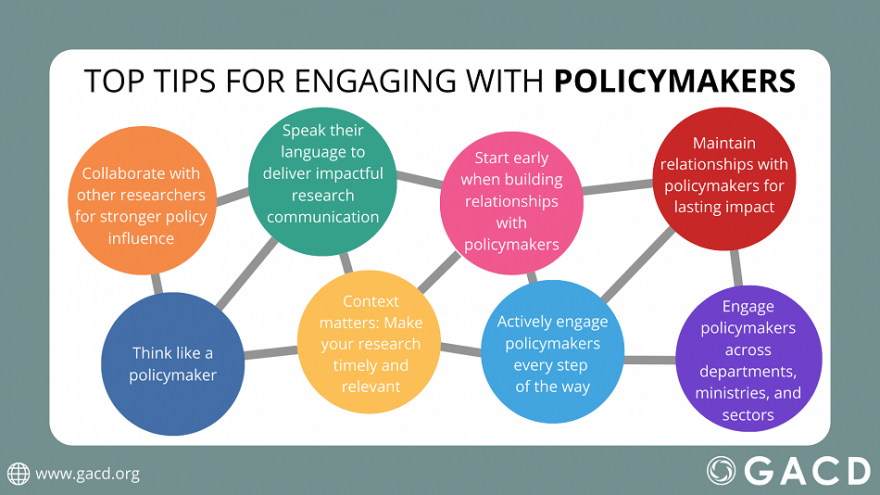
The GACD team has developed eight top tips for researchers when engaging with policymakers and influencing the policy process.
Here are GACD’s eight top tips for effective engagement with policymakers, along with practical examples from GACD projects. Click on each tip below for in-depth insights on implementing the tips and practical examples drawn from GACD projects.
-
Policymakers and researchers often have different goals and priorities. To engage with policymakers effectively, it is important to understand how policymakers think and what matters to them.
How?
Put yourself in the shoes of the policymakers and consider these questions:
What questions are policymakers asking?
What are their priorities?
What are the key issues that they want to address?
What information do they need to support decision making?
In action
The INTE-AFRICA: Integrating and decentralising diabetes and hypertension services in Africa project integrated care for diabetes and hypertension with HIV care in Uganda and Tanzania.
The Ministry of Health in both countries recognised that HIV care was working well, but diabetes and hypertension care (particularly retention in care) needed to be improved and asked the project team to test an integrated model of care. Changing from the stand-alone disease specific care model to integrated care was risky and controversial and the project team were sensitive to this.
Engaging Policymakers
By adopting a policymaker’s perspective and their priorities, the project team established strong relationships with policymakers. The team recognized key concerns from policymakers (for example during elections there was a lot of interest in community care) and the data needed to support decision making (including cost-effectiveness data).
Collaborative Efforts
Policymakers identified the questions that they would like answered through the research and actively participated in study design and project implementation. The project team communicated regularly with Ministry of Health officials through monthly newsletters, virtual and in-person meetings, and periodic progress reports, providing evidence needed to support the policymakers in informed decision making. The project team and policymakers jointly interpreted and disseminated the findings.
For further information, visit the project web page.
-
The context in which evidence is provided has a huge impact on its use by policymakers. Ensuring that research is both timely and relevant to the policymaking process is key.
How?
Understand the political context, competing agendas, financial constraints, and timescales governing policymakers’ decisions. This can be done through active engagement in policy dialogues, discussions with policymakers, and scoping reviews of existing policies.
Become familiar with existing government policies, strategic plans, and associated timelines.
Whenever possible, identify potential future policy issues that your research can address. Acknowledge that research takes time and during its course, the policy issues and priorities in the country may change.
Find out if your institute has a policy department or knowledge exchange team who can offer advice and support.
In action
The SCUBY: SCale Up an integrated care package for diaBetes and hYpertension for vulnerable people in Cambodia, Slovenia and Belgium project team effectively conducted policy dialogues and developed scale-up roadmaps to achieve their objectives.
These context-specific scale-up roadmaps (including various interventions) are intended to offer avenues of action and policy direction and are built on two pillars:
Evidence: The roadmap drew heavily from the formative phase findings within the SCUBY Project, highlighting the importance of evidence.
Stakeholder engagement in policy dialogues: The second important pillar of the roadmap involved engaging stakeholders in policy dialogues to receive inputs, feedback, and further refining policy directions while co-creating the key recommended strategies. Due to this continuous engagement with stakeholders in policy dialogues, the roadmap can continue to be adapted over time.
Key learnings from the SCUBY project’s use of policy dialogues include:
Get to know your stakeholders before organising a policy dialogue
As part of the policy analysis, the project team analysed institutional webpages to understand the organisational vision, mission, priorities and to map power dynamics and interests. They reviewed policy documents and conducted stakeholder interviews to understand which stakeholders were ‘in’ (e.g. involved in the development or implementation) on a certain policy reform and which were not. These activities were important in understanding the interests and positions of stakeholders and identifying the existence of alliances and networks.
Formulate clear objectives and targets of the policy dialogue
These will change depending on the phase in the policy cycle. Each SCUBY project country team held an early meeting with various stakeholders with the following objectives:
Informing stakeholders and policymakers of the current evidence
Getting feedback and refining the roadmap
Priority setting and consensus building
In Belgium and Cambodia, the project teams supported the policy formulation and decision-making phase by bringing evidence to policy, facilitating engagement, identifying leadership, and creating network-partnerships. The project teams found that follow-up (e.g. a policy brief presenting an evidence synthesis) is key to keeping the momentum going, keeping the communication channel open and collaboration ongoing. Also, when there was an opportunity, the project team proactively shared preliminary findings, thus providing stakeholders with valuable insights from the evidence and strengthening support for informed policy directions and decisions.
Build synergies across (research) projects and/or organisations
Leverage opportunities (e.g. a conference where policy makers are present; a call or event organised by policy makers) to collaborate with other organisations who can introduce you to policymakers. This approach will enable your research team to become part of a larger network interested in policy change.
Participate in a committee to get to know various stakeholders and organisations within (or outside of) your discipline
Each SCUBY country team had at least one member (often a professor or senior researcher), with a large network across the health sector. As the project progressed and more stakeholder interviews and policy dialogues took place, the younger team members also gained boundary spanning skills and were able to tap into that wider network. This progressive engagement not only increases the recognition of the research project but also highlights the importance of building informal contacts and reputation to build alliances for more sustainable policy change.
Ongoing monitoring of the process and progress
In all three countries, the major policy dialogues were registered using a policy dialogue reporting form, on which the project teams would note down the meeting minutes and describe key success factors, barriers and progress made. This ensures transparency and informed decision-making.
For further information, visit the project web page.
-
Early engagement with key policymakers, starting in the early stages of research planning, increases the likelihood that the evidence generated through the research will influence policy decisions. Policy engagement is most effective when it is based on long-term relationships between researchers and policymakers, built on trust and mutual respect.
How?
Identify which level of policymakers (local, district and/or national) to engage with, based on the intervention or policy issue being considered and who has the decision-making power.
Actively seek input from policymakers on their priorities, information that they need, and listen to their perspectives.
Involve policymakers in shaping research questions and design the project to address the problems that they identify.
Collaborate with local organisations who may already have established relationships with policymakers.
Hold smaller meetings with policymakers prior to large multi-stakeholder meetings to provide time and space to for them to articulate their ideas and concerns.
Proactively start building relationships with new policymakers as soon as possible when policymakers change, despite potential challenges.
In action
The SMART2D: A people-centred approach through Self-Management and Reciprocal learning for the prevention and management of Type-2-Diabetes in Uganda, South Africa, and Sweden exemplified early policymaker engagement.
In all three sites the project teams engaged with policymakers before the start of the project:
In Uganda, policymakers at the Ministry of Health received briefings through a workshop involving key officials, including the NCD Commissioner and District Health Officers. Engagement with policymakers included periodic meetings, workshops, and key informant interviews to better understand existing policies, procedures, infrastructure for diabetes care.
In South Africa, local level engagements took place with the Director of the Khayelitsha Eastern Sub-Structure (KESS) of Cape Town Metro Health Services before, during and after project implementation. Before the start of the project, a meeting was held at the KESS Office in Khayelitsha to introduce the project and discuss strategic policy objectives as well as aligning SMART2D goals with these objectives.
In Sweden the project team engaged in a consultative process with selected primary care centres and local municipality offices (citizens offices) during the project’s formative phase. The team sought to understand current practices, community perspectives, and discuss intervention strategies. The project team received written commitment from participating health centres during the proposal stage. However, structural changes in primary healthcare administration in the Stockholm region required project adaptation to a feasibility trial.
Project teams sustained engagement with policymakers throughout the project using diverse methods tailored to each context. For instance, in Uganda, the principal investigator is a member of the NCD Technical Working Team and held routine updates. In South Africa, regular feedback was essential to sustain the relationship with policymakers, while in Sweden, responsibilities for diabetes screening were integrated into the workplans of a new cadre of outreach workers
For further information, visit the project web page and case study.
-
Actively involving policymakers throughout the research process is key to achieving impact, yet they are often passive recipients of research results which can hinder the translation of research findings into policy action. Collaborative efforts that involve policymakers as partners rather than consumers, enhances the relevance of research and increases the likelihood that it will impact policy.
Policymakers may look for expert opinion before final results are published and may ask for advice from researchers with whom they have established relationships. Regular engagement can also help researchers to be aware of emerging issues and changing priorities in the policy landscape.
How?
Involve policymakers as integral members of the project team, valuing their expertise and their understanding of the context and the health problem.
Provide policymakers with intermediate findings, rather than awaiting final research results.
Maintain an ongoing and open dialogue with policymakers through regular communication, seeking their input and perspectives. This sustained engagement helps nurture strong relationships and ensures that research aligns with evolving policy priorities.
In action
The TB and Tobacco project exemplifies the power of actively engaging policymakers throughout the research project. The project team engaged with the National TB Programmes (based at the Ministries of Health) in Bangladesh, Nepal, and Pakistan at the early stages of the project, before applying for the grant. Each of the three national TB programmes nominated a focal person to work with the project team.
In Pakistan, the focal person was a senior member of the National TB Programme who became a co-investigator, contributing invaluable insights that led to policy and practice change. Her involvement facilitated the inclusion of project interventions in the national TB strategic plan, including the intervention in Global Fund applications submitted by the national and provincial TB programmes, and prompted the modification of TB health worker reporting forms to include patient tobacco use status and cessation advice, a critical step in patient care. Her contribution to scientific outputs helped to ensure that they were grounded in reality and useful for the National TB Programme.
In Bangladesh and Nepal, challenges arose due to staff turnover within the National TB Programme in Bangladesh and constitutional changes in Nepal, making it difficult to establish lasting relationships within the Ministry of Health. Despite these challenges, the project maintained its connections with TB program managers, emphasizing the significance of continuity in policymaker engagement.
For further information, visit the project web page, and refer to the case study, and publication on lessons learned from scale up.
-
Engaging with a range of policymakers from diverse sectors is essential when research goes beyond the health sector. For example, a project operating within educational settings should actively involve policymakers from the Ministry of Education and the Ministry of Health.
How?
Identify which government ministries are relevant to the research topic.
Identify and participate in any intersectoral topic- specific working groups, if these exist.
Identify and work with any civil society or advocacy organisations already engaging with a variety of policymakers on related issues.
Employ the strategies mentioned above to build relationships with policymakers from different sectors.
In action
The NaSS study: Evaluating the Implementation and Scale-Up of Nigeria National Sodium Reduction Programme serves as an exemplary model of multisectoral stakeholder engagement. In November 2021, the NaSS team, in collaboration with the National Agency for Food and Drug Administration and Control (NAFDAC), co-organized a multi-stakeholder meeting of 450 participants to facilitate cross-sectoral collaboration, dissemination of findings, and multi-level policy coherence among sectors including food, health, trade, and law. Notable attendees included representatives from the Nigeria Federal Ministry of Health, Ministry of Education, WHO, Resolve to Save Lives, academia, food industry, media, and the wider community.
The NaSS project team recognised the importance of including stakeholders from sectors beyond the Federal Ministry of Health and including more Federal Ministries, particularly Education, Information, Planning and Budget, and leveraging the National Multisectorial Action Plan to ensure buy in from policymakers.
For further information, visit the project web page.
-
Policymakers operate in fast-paced environments so concise and accessible communication materials are most likely to gain their attention.
How?
Write policy briefs which are a useful tool for communicating research findings. They are most effective when used within an established relationship with policymakers and can serve as a springboard for discussion.
Recognize that in many cultures, there is a preference for oral briefings over written communication. Prepare to provide policymakers with the most relevant information during such meetings and be ready to address their questions.
Employ a range of communication tools including research summaries, blogs, social media, infographics, responding to consultations, participating in working groups, media engagement, workshops, and conference presentations.
Present the research findings in a way that is relevant to policymakers. Remember that the most important findings in policy terms may not be the main highlights of academic papers. Highlight aspects like economic considerations, cost-effectiveness, and feasibility of implementation within their specific context
Include clear messages and recommendations tailored to address a particular policy problem.
Keep your communication materials brief (ideally 1-2 pages), ensuring they are easy to read and understand. Explain the implications of the research findings and any caveats or unknowns.
Enhance engagement by including real stories and images that humanize the interventions and show the people impacted.
In action
The Scaling up food policy interventions to reduce non-communicable diseases in the Pacific Islands project team has developed communication materials for policymakers that include clear and succinct messages, key statistics, and infographics. They communicate in a way that is quickly accessible by policymakers and highlights key findings from the research and why further policy interventions are needed.
The infographics for policymakers can be found here.
For further information, visit the project web pages here and here and case study.
-
Policy change takes time and often unfolds over several years, extending beyond the conclusion of the original research grant. Continuously engaging with policymakers even after the end of the research grant increases the likelihood that research findings will be taken up into policy and provides an opportunity for policymakers to shape future research.
How?
Discuss the research findings and their relevance to policy. If this is done through a workshop, it is important to give everyone the opportunity to participate and ask questions and ensure that they understand the research results.
Stay actively involved in working groups and policy discussions after the research grant has ended.
Proactively involve policymakers in the design of the scale up project, if the project is being scaled up.
In action
The Community Health Assessment Programme in the Philippines (CHAP-P) is a drop-in diabetes and cardiovascular risk assessment, health promotion, and disease prevention programme. CHAP-P has been scaled up across an entire administrative region of the Philippines, Region IX, Zamboanga Peninsula.
From before the project’s inception, the CHAP-P research team built relationships with policymakers at all three levels of the healthcare system (National/Regional, Provincial, Municipal). Policymakers’ insights helped tailor CHAP-P to community needs, emphasizing integration into the healthcare system strategy while maintaining transparency about potential impacts and post-research sustainability. Collaborative efforts between the project team and policymakers clearly defined roles, training, and resource allocation.
Throughout the implementation, the CHAP-P research team updated policymakers about the progress, future targets, and next steps. Local health workers (lay volunteers in collaboration with public health staff) took charge of the programme while the research team assisted and monitored the implementation and evaluated the outcomes.
By the end of the research program, local health policymakers and healthcare workers will assume full responsibility, due to CHAP-P’s integration into local, provincial, and national health strategies and the involvement of local healthcare workers and policymakers from the start of the project. This approach ensures long-term sustainability, reflecting optimism for CHAP-P’s continued local impact.
For further information, visit the project web pages here and here.
-
Collaborating with other researchers and engaging policymakers together can increase impact and save policymakers’ time.
How?
Leverage the power of GACD projects working within the same country to join forces and engage policymakers effectively together.
Leverage existing relationships that long standing GACD projects have with policymakers to introduce researchers from new projects to policymakers.
Collaborate at a global level through GACD working groups and use evidence from several countries to influence policy.
In action
The GACD Multimorbidity Working Group, drawing together 58 researchers from GACD projects, has developed a joint statement and a policy brief to draw the attention of research funders and policy makers to the importance of multi-morbidity research.
For more information, see the case study.
Would this content be useful for a friend or colleague?