
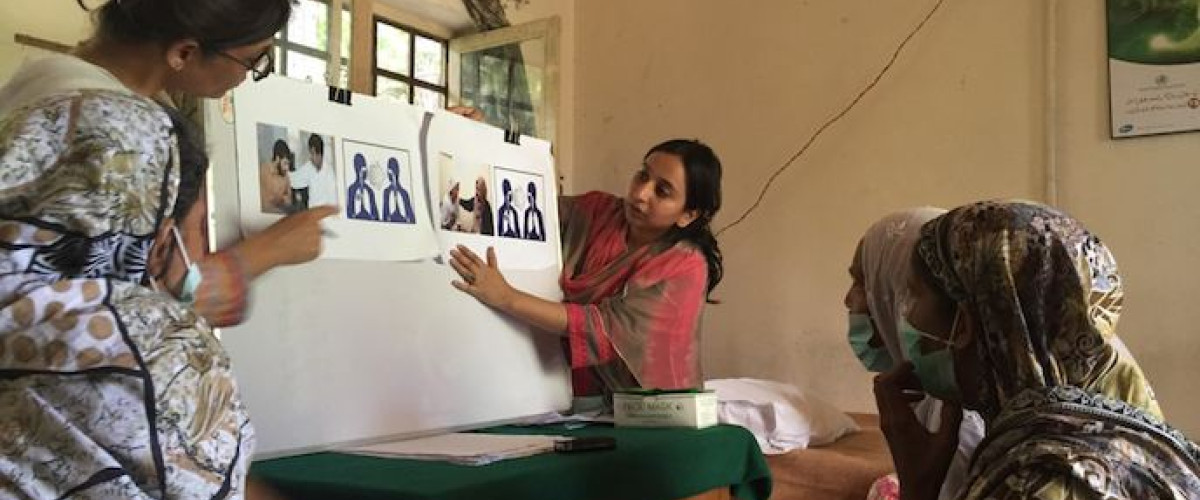
The GACD-funded TB and Tobacco project sought to address an implementation gap and improve the health of TB patients through integrating smoking cessation interventions into routine TB care in Pakistan, Bangladesh, and Nepal.
Tuberculosis (TB) continues to be a substantial global health issue, with many TB patients living in Pakistan, Bangladesh, and Nepal. The high prevalence of tobacco smoking in these populations exacerbates the issue as TB patients who smoke are at higher risk of faster and more severe disease progression and have a greater likelihood of dying from TB.
Supporting TB patients to quit smoking can help them to recover from their TB, protect their families and live healthier lives. Although effective, evidenced-based interventions to help people quit smoking exist, their implementation across different health systems remains inconsistent.
The GACD-funded TB and Tobacco project sought to address this implementation gap and improve the health of TB patients through integrating smoking cessation interventions into routine TB care in Pakistan, Bangladesh, and Nepal.
All TB patients who smoked received behavioural support delivered by TB health workers. In addition, half received a smoking-cessation drug Cytisine while the other half received placebo. The research took place between November 2015 and October 2019.
The study found that short and simple counselling provided by a TB health worker in routine care helped almost a third of TB patients who smoked to quit, and that those who quit smoking had significantly better TB outcomes than those who didn’t. Cytisine did not offer much additional benefit.
Policy engagement activities took place in all three countries and brought together those involved in policy making for TB programmes to learn about the study’s findings and discuss how to incorporate these within their policies and plans. The project aimed to engage with policymakers from the beginning but had different levels of success in each country.
Embedding the research within TB programmes was a key implementation strategy, which worked well in Pakistan where members of the provincial and federal government were involved as researchers within the team. It was more challenging in Nepal due to the changing structures and personnel due to Federalisation. In Bangladesh the centralised nature of government and frequent turn-over within the National Tuberculosis Programme also raised challenges.
The project team engaged with the World Health Organization (WHO) at regional and global levels and brought together WHO TB staff and WHO tobacco control staff.
The project investigated the potential for scaling up the simple counselling intervention. This helped the project team to identify levers for change within the health system and to gain insights on what enabled impact. These findings coupled with detailed discussions with national TB programme staff helped the project team to identify the following health systems changes needed for scale up:
Changing reporting forms to include tobacco;
Adding training on cessation support to the routine TB programmes; and
Revising TB policies.
The research has led to increased integration of tobacco cessation within National Tuberculosis Programmes in Pakistan, Bangladesh, and Nepal.
This has generated impact on policy, training, integration within routine care and surveillance at national and global levels:
Policy: Inclusion of tobacco cessation support in Pakistan Chest Society’s national TB clinical guidelines and Pakistan’s national strategic plan.
Training:
Inclusion of tobacco cessation within national training guidelines in Nepal.
Ministry of Health and Family Welfare in Bangladesh committed to providing tobacco cessation training to TB health workers.
Across the three countries, 137 TB health workers have been trained in tobacco cessation using the project’s training materials. Following the end of the project, further health worker training has taken place within the TB programme in Bangladesh and Pakistan.
Integration in routine TB care: Integration of tobacco cessation within routine care in all 121 TB clinics in Khyber Pakhtunkhwa Province in Pakistan.
TB programme surveillance:
In Pakistan, the addition of tobacco smoking status to the routine TB recording system will remind health workers to ask all patients (est. 218,222 annually) about their tobacco use.
In Bangladesh, the National Tuberculosis Programme technical committee plan to include tobacco within TB surveillance.
In addition to national impact in all three countries, the research has led to global impact:
Inclusion of key messages from the study’s behaviour support intervention within the WHO TB-Tobacco mHealth guide which is now being rolled out in Egypt and India.
Inclusion of the study’s recommendation within the International Union against TB and Lung Diseases’ white paper on the integration of tobacco within TB programmes.
Would this content be useful for a friend or colleague?