
The increasing rate of non-communicable diseases (NCDs) in Indonesia requires targeted and specific primary and secondary prevention.
Nearly one-third of adults in Indonesia have hypertension, yet less than 30% are aware of their hypertension status, and only 47% of people with diabetes are aware of their diabetes status. Therefore, screening for hypertension and diabetes is important to address the growing burden of NCDs in Indonesia.
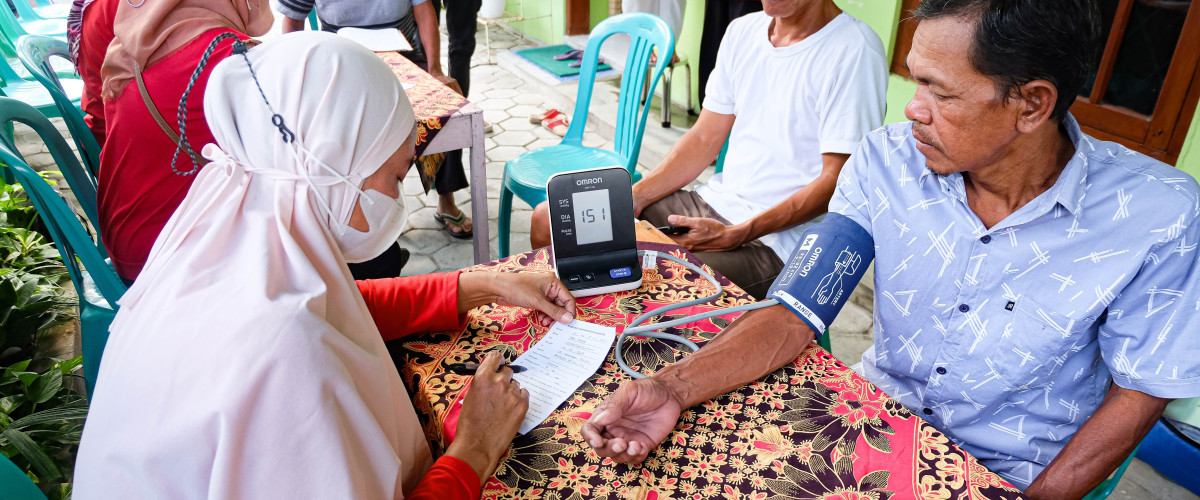
In 2011, the Ministry of Health (MOH) in Indonesia launched the Integrated Health Post (Posbindu) as a community-based screening and prevention programme for NCDs. The Posbindu is an extension of the work of primary healthcare facilities, known as Puskesmas in Indonesia and has gradually expanded across the country. However, previous studies have highlighted challenges in the optimal implementation of Posbindu and lower participation rates among younger people and males.
Over 80% of participants were female, and more than half were over 50 years old. The quality of screening was insufficient, with less than a quarter of Posbindu participants reporting being interviewed about NCD risk factors, fewer than 80% undergoing anthropometric measurements, and less than 15% receiving blood cholesterol examinations.
Additionally, other studies also indicate that although effective pharmacological treatment is available, patient adherence to antihypertensive medications is known to be suboptimal, leading to poor health outcomes. While a national guideline on NCD screening exists, previous evaluations revealed the need for improved operational tools for the community health volunteers (known as cadres).
Based on a key stakeholder meeting with health officers, village midwives and nurses, cadres and Posbindu participants, it was determined that the key to success lies in the collaborative efforts of stakeholders. Establishing effective coordination between Posbindu cadres, Puskesmas officers, and the Department of Health is crucial for improved resource allocation. Additionally, the importance of synergy between cadres, health centres, and the health office was highlighted for enhancing the overall quality of healthcare services and successful interventions.
As part of the SUNISEA project, a simplified algorithm for community-based screening was developed and implemented. This initiative aligns with Indonesia’s ongoing primary healthcare integration as part of its health systems transformation. The simple screening algorithm is used to identify people with NCD risk factors, especially hypertension and diabetes and to identify those who need referral.
The SUNI-SEA project developed a training programme for cadres, consisting of interactive sessions to improve knowledge and attitude regarding NCDs and the algorithm. This was followed by practical sessions and simulation to improve skills. A total of 92 cadres were trained under this programme. While there was an immediate increase in knowledge levels after the training, they declined after four months, though skill levels showed some sustained improvement. This highlights the need for regular supervision, on-the-job training, and refresher courses to maintain knowledge and skills.
Cadres expressed that the practical activities in the training can improve their skills in implementing algorithms and conducting health checks in Posbindu activities.
“The cadres have been able to check blood, have received sticks for glucose check, many cadres have come to check blood glucose for free, and have attended SUNI-SEA training and also training from PHC to take measurements.” (Health worker from PHC in Batang).
“After the training, we become more knowledgeable about Posbindu activities and know about non-communicable disease and also how to prevent it. We were also trained to carry out health checks at Posbindu. We become able to do the health checks at in Posbindu activities” (Cadre from Kediri).
Observations of the cadres’ skills and practice showed improvements, and this was also reflected in Posbindu participants’ satisfaction.
“Posbindu activities really helped me, I could know my health conditions regularly through blood pressure and blood glucose checks in the Posbindu activities.” (Posbindu Participant from Kediri).
Data on referral to Primary Health Care was obtained for a subset of Posbindu participants, revealing that despite nearly 80% of high-risk individuals being identified, less than 8% were referred. Reasons for non-referral included participants being advised to return for recheck at the next Posbindu activities (55.6%), receiving medication during Posbindu activities (22.9%) by collaborating health professionals, or being provided with education on maintaining a healthy lifestyle (10.2%). This shows the value of community-based early detection of risk factors. However, barriers to accessing healthcare such as the distance to the nearest healthcare centre, also contributed to non-referral.
“The primary healthcare facility is far away from my home, so even though it’s free, there are still costs for a motorcycle taxi or transportation to get there and the costs can be more expensive than the medicine. So, it’s better to go to the midwife or just buy medicine in the pharmacy, even though I have to pay, it’s closer to my home.” (Posbindu participant from Batang).
The algorithm for community-based screening has improved the implementation fidelity among cadres. Hence, the simplified screening algorithm could be used to strengthen NCD screening as part of community-based health services provided by the cadres. However, continous training for cadres using various methods including simulation, video review and on-the-job refresher training is needed. Therefore, to ensure sustainability, the SUNI-SEA project team calls for action from community authorities, primary health care and province/district health offices to allocate financial support for implementing the NCD algorithm.
Would this content be useful for a friend or colleague?