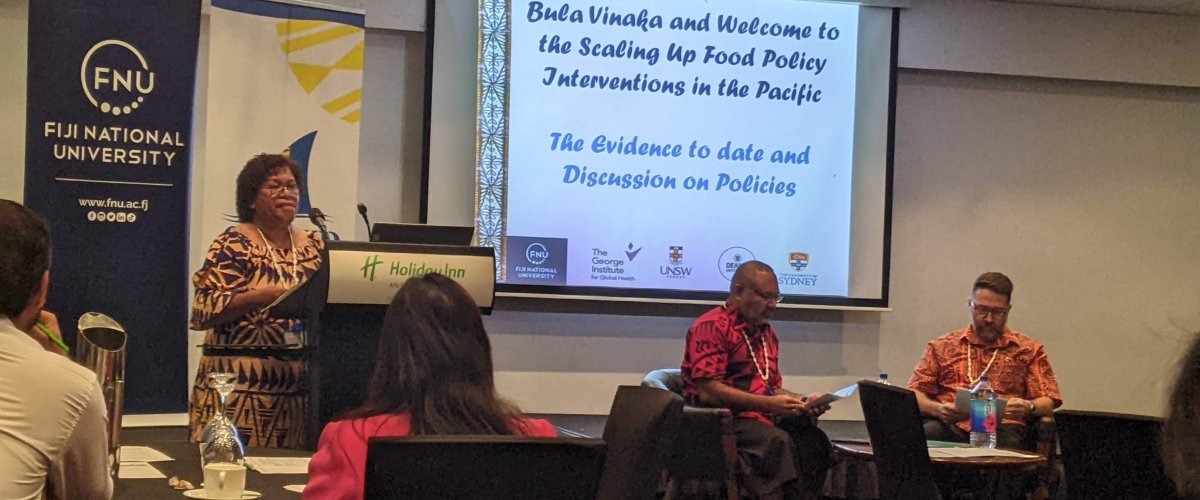
A GACD-funded project is helping Fiji strengthen food policies by translating research into action, supporting healthier diets and reducing the growing burden of non-communicable diseases across the Pacific.
Pacific Island Countries are facing one of the world’s most severe epidemics of obesity, type 2 diabetes, cardiovascular disease and other non-communicable diseases (NCDs). Despite decades of health promotion and increasing public awareness of healthy eating, rates of NCDs continue to rise.
This suggests that knowledge alone is insufficient to change behaviour when people live in food environments where unhealthy choices are cheaper, more accessible and more convenient than healthy alternatives. Processed and packaged foods like instant noodles are easy and cheap and contribute to the rising rates of obesity, hypertension and diabetes in the Pacific. The consequences extend far beyond health. These non-communicable diseases account for an estimated 5-10% of GPD in Pacific Island Countries and Territories compared to around 3% globally.
Also, more families are using their own money to pay for healthcare. Out-of-pocket health spending now exceeds 10% of household budgets for 1 in 5 households, compared with 1 in 10 previously.
To help address this growing crisis, Pacific Island leaders are implementing regulatory and fiscal policies, including taxes, nutrient targets for processed foods, and school food guidelines designed to prioritise disease prevention and alleviate the crisis.
In line with these efforts, the 5-year ‘Scaling up food policy interventions to reduce non-communicable disease in the Pacific Islands’ project (2019-2024) provided the Ministry of Health in Fiji with evidence to design and implement policies and interventions for reducing salt and sugar consumption. Earlier research had identified excessive salt and sugar intake as key contributors to poor health outcomes and reduction strategies.
A unique feature of the project was its collaborative approach. The Ministry of Health staff as well as regional development partners such as the Pacific Community were involved in the research design and throughout the research process. This partnership ensured that the research addressed real policy needs and increased the likelihood that evidence would be translated into action. The evidence generated through the project directly informed Fiji‘s Ministry of Health and Medical Services Strategic Plan 2026-2031 launched in June 2026. The strategy marks a turning point in Fiji’s Health System, shifting from responding to illness to proactive prevention. Publications, authored by researchers from Fiji National University, Ministry of Health staff and researchers from Universities in Australia contributed to this evidence base. These covered topics including:
An analysis of Fiji’s nutrition-related policy landscape
Insights into the impact of COVID-19 on food security and diets
Quantification of sugar and salt intakes
The nutrient content of packaged foods available in Fiji
Ultra-processed food consumption
Population perspectives on ways of reducing sugar and salt in diets
To ensure the evidence was accessible to decision-makers, the project team also developed communication materials specifically for policymakers, with clear and succinct messages, key statistics, and infographics. These are highlighted in GACD’s Top tips for engaging with policymakers. The project also strengthened policymakers’ ability to use evidence through a two-day food policy workshop, hosted by the Ministry of Health and the Fiji Consumer Council. Health behaviour change in the community was targeted through campaigns promoting healthier behaviours on social media.
The project boosted regional research capacity through financial support for two Fiji National University staff and 12 research assistants, along with the provision of training in dietary assessment methods. Research infrastructure was built by adapting an online open-source dietary intake assessment platform (Intake24) to be used in Fiji, by adding commonly consumed Fijian dishes and ingredients, in addition to application/tablet based survey software developed for data collection. Also, additional questions on salt, sugar and processed food were added to the Fiji 2025 Steps Survey. Regional research capacity was built through the provision of technical guidance on grant application and peer-reviewed manuscript preparation with more than 50 researchers and health professionals from across the Pacific and through the provision of six scholarships for Pacific health practitioners and researchers to receive training in healthy food retail.
The success of the project shows the value of bringing together researchers, policymakers and practitioners to co-design solutions for complex public health challenges. These partnerships will remain essential for strengthening food policy and reducing chronic disease in Pacific countries.
This research was funded by the Australian National Health and Medical Research Council (NHMRC) under the Global Alliance for Chronic Diseases (GACD) Scale Up Research Programme.
To access publications relating to this project, see GACD’s publications webpage (filter by project SU18 – Scaling up food policy interventions to reduce non-communicable diseases in the Pacific Islands)
For more information about this project, please contact Jacqui Webster, University Technology of Sydney (UTS).
Would this content be useful for a friend or colleague?